

A client wrote in recently with one of the better questions I have gotten in a long time. They own a portfolio of rental properties, roughly a dozen. Their bank and their accountant had walked them through what a full separation strategy would actually require: a separate LLC for each property, a separate bank account for each LLC, separate state filings, separate bookkeeping, and a bigger bill from the accountant every year.
Somewhere in the middle of that conversation, a reasonable question surfaced:
If LLCs are that good at protecting assets, why do we need so many? And if courts allow one LLC to be broken, what keeps someone from breaking each one, one at a time?
That question is sharper than it looks. But before I answer it, I want to push on a premise buried inside it.
How Easy Is It, Really, to Break an LLC?
The question assumes that courts break LLCs with some regularity. That assumption is worth a hard look, because it arrives from two directions at once, and both of them have something to sell.
Formation mills sell the entity as automatic protection, which sets people up to believe the wall is absolute. Then the asset protection marketers sell the opposite story, that the wall is fragile and you need more walls, ideally purchased in bulk from them. A property owner sitting between those two pitches ends up believing both: the LLC protects everything, and also the LLC breaks easily. Those cannot both be true.
The reality is that piercing the veil is an extraordinary remedy, and courts treat it that way. In Colorado, a creditor has to establish three separate things: that the entity is merely an instrumentality of its owner, with such unity of interest and ownership that the separate personalities no longer really exist; that the entity form was used to perpetrate a fraud or defeat a rightful claim; and that piercing produces an equitable result.1 The Colorado Supreme Court has also instructed courts to look for alternative remedies before reaching for this one, and has cautioned that an equitable result is not achieved when innocent parties are prejudiced.2
Colorado's LLC statute adds a protection that gets very little attention. The legislature specifically provided that an LLC's failure to observe formalities relating to the management of its business is not, by itself, grounds for imposing personal liability on its members.3 Missed meetings and thin minutes are not the trapdoor they are often marketed as.
Note the qualifier, though. A lapse is not grounds for liability in itself, which leaves a court room to weigh it alongside everything else. And a requirement you wrote into your own operating agreement and then ignored reads worse than a ceremony you never adopted at all, because not doing what you said you would do is evidence of exactly the disregard a creditor is trying to establish. That is why we counsel against operating agreements stuffed with ceremonies nobody intends to perform.4 The absence of a formality is not evidence against you. A broken promise to observe one can be.
So the honest starting point is that a well-run LLC is considerably harder to break than the internet suggests. Which makes the client's question better, not worse, because it means the real question is what happens in the narrow band of cases where a creditor does get through.
Two Different Fights, Two Different Answers
Before going further, it helps to be precise about which direction the risk is running, because the entity count matters enormously in one direction and very little in the other. These two situations get confused constantly, even by attorneys, and they have almost nothing in common except that an LLC is standing in the middle of both.
Inside-out liability. The claim starts inside the entity and reaches out toward the owner. A tenant is injured on the stairs at one property, and the lawsuit names the LLC that owns it. The creditor's first job is easy: collect against that LLC's assets, which is the property itself. If the judgment is larger than the property is worth, the creditor has to get past the entity wall to reach anything else, either the owner personally or the other eleven properties. That is the veil-piercing fight, and it is where the number of entities does real work.
Outside-in liability. The claim starts with the owner and reaches in toward the entity's assets. The owner causes a serious car accident on a Saturday afternoon, personally, with nothing to do with any rental property. Now the judgment is against the human being, and the assets that human being owns are twelve membership interests. Here the creditor is not knocking down walls at all. The creditor is going after the ownership interests directly, through charging orders, and whether those interests are meaningfully protected depends on state law, the number of members, and how the structure was built.5
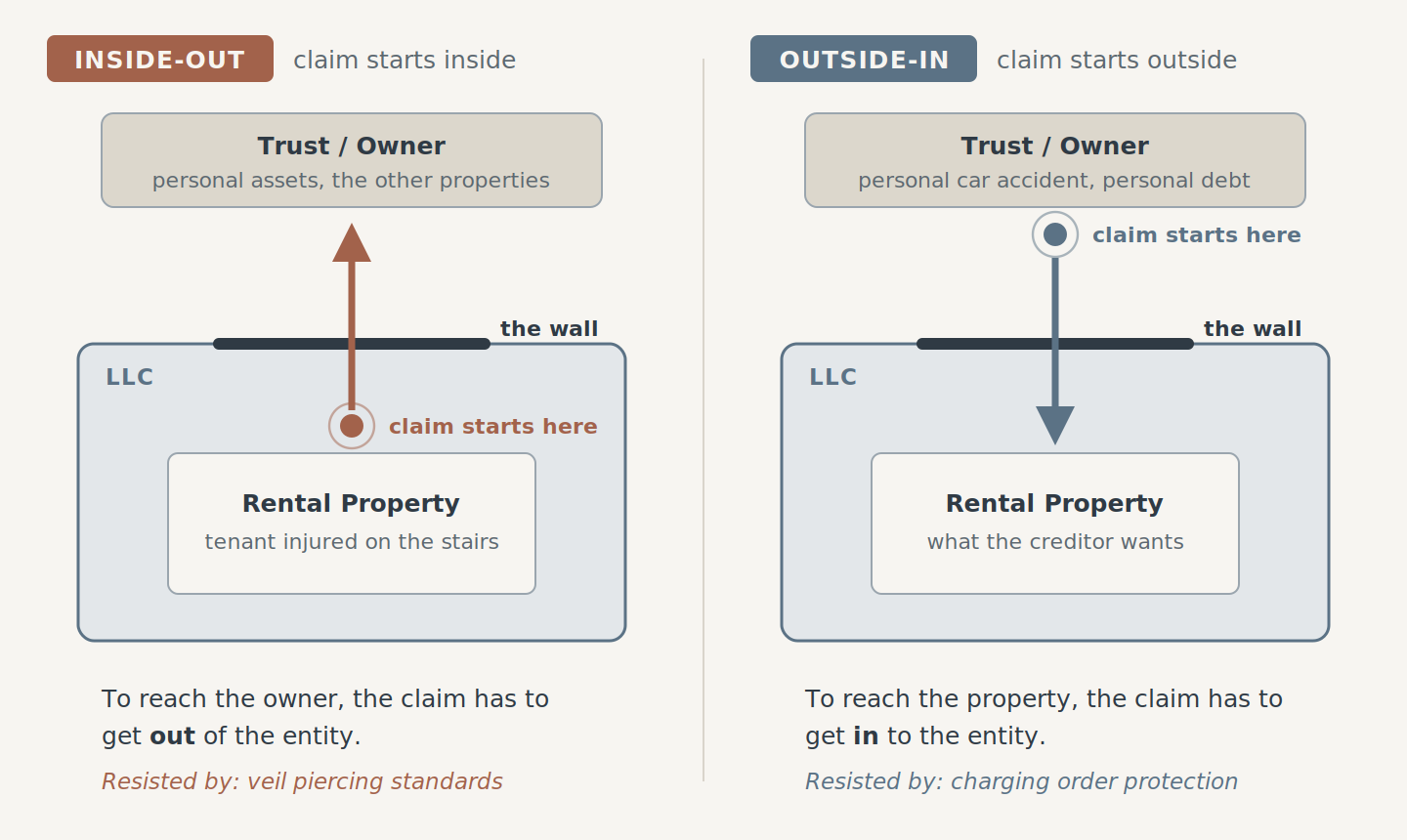
The entity count is an inside-out strategy. Against an outside-in claim, twelve entities do not help more than one would, and twelve single-member LLCs in a state like Colorado may simply present twelve versions of the same known weakness.6 Wyoming closed that door by statute. I practice in Colorado. Matt Meuli, my colleague, is the one of us licensed in Wyoming, and he is the reason I know as much about that statute as I do.
If a plan treats the entity count as general-purpose armor, it will disappoint in the direction it was never designed to cover.
Where the Concession Has to Be Made
Now I want to give the accountant's objection its due, because part of it is correct and I would rather say so plainly than have a reader discover it later and wonder what else I skipped.
Colorado does not require proof of bad intent to pierce an LLC's veil. In a 2012 decision, the Court of Appeals affirmed piercing a single-member LLC without any finding of wrongful intent or bad faith, holding that using the entity form to defeat a rightful claim was enough, and that a potential creditor counts, not only an existing one.7
The facts are worth knowing, because they bound the holding. As the opinion recounts, the company "sold its only meaningful asset, an airplane, for $300,000, and the proceeds of that sale were diverted to Freeman, who paid Tradewinds' litigation expenses." The trial court also found the company's assets commingled with the owner's personal assets and with those of a second entity he controlled, which had been using the airplane without agreement or compensation, and that undocumented infusions of cash were required to cover the company's operating expenses.
Notice what that is and what it is not. He was not looting the company and disappearing. He took the sale proceeds into his own hands and paid the company's legal bills out of them, which is close to what a well-meaning owner does when the company is short and the lawsuit still has to be funded. It is also the precise behavior that erases the line between the person and the entity. The dissent argued that the majority had stretched an extraordinary remedy past its purpose. The dissent did not carry the day.
So the owner was not a fraudster, and the court required no finding that he was. He also was not running a clean company.
The concession is this: piercing in Colorado is not reserved for con artists, and an owner who intended nothing dishonest can still lose the argument on the strength of how the entity was run. What the case does not show is a well-kept entity falling to a creditor. It shows a company whose separateness had dissolved in practice long before anyone asked a court about it.
That narrows what I can promise. What it does not do is establish that one loss travels to the next entity, which is the actual question on the table.
Why One Loss Does Not Cascade
Here is the part with a genuinely reassuring answer, and it comes from a Colorado case that has not traveled much outside the bar.
In 2020, the Court of Appeals addressed what happens when a creditor wants to reach a sister entity, meaning one that shares an owner with the entity that got sued but has no direct ownership relationship with it. The court held that this kind of horizontal piercing is available in Colorado, which is the bad news. The good news is how it has to be done. The creditor must pierce upward from the first entity to the common owner, establishing alter ego at that step, then pierce back down from that owner to the sister entity, establishing alter ego again at that step. Each link requires its own findings on its own facts.8
And that case is a demonstration rather than a hypothetical. The creditor there had already won at trial. The Court of Appeals reversed, because the trial court had never made the findings each link required. Winning the first fight did not carry the second one.
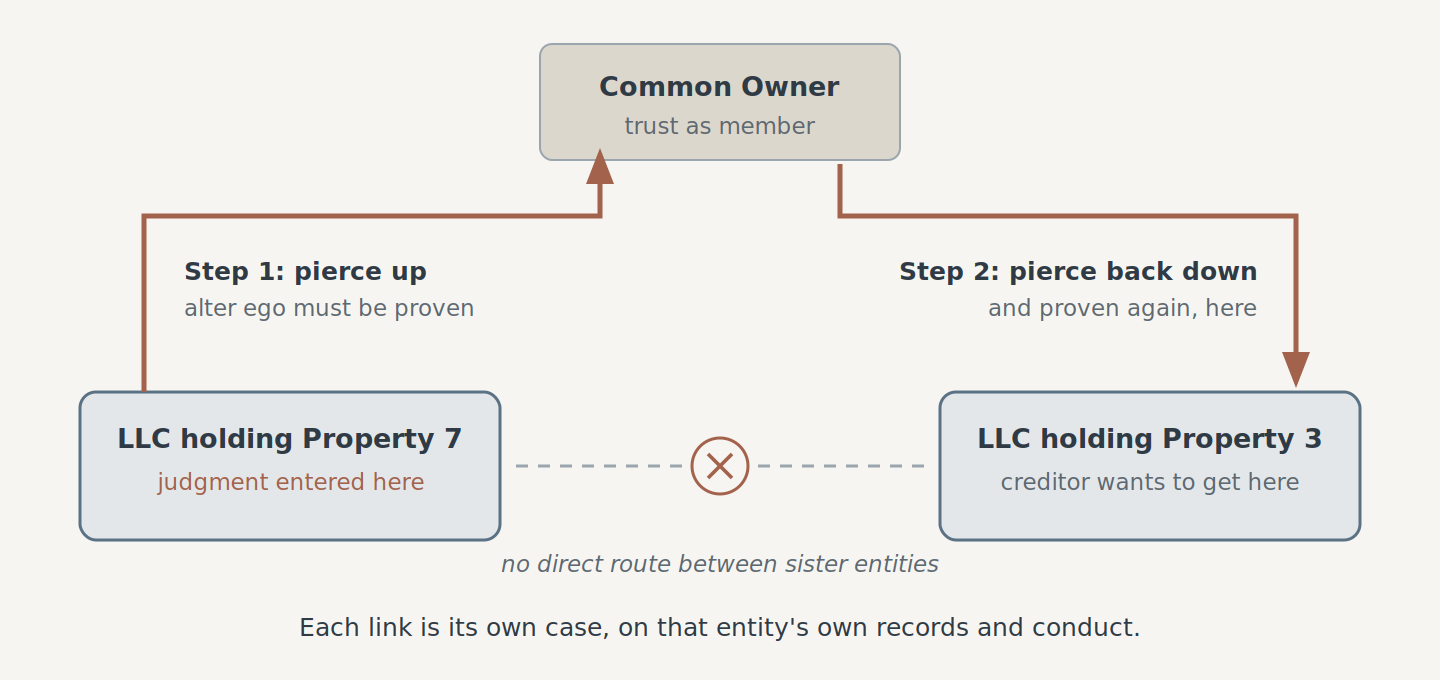
That structure is the real answer to "what keeps someone from breaking each one, one at a time." A judgment against the entity holding Property 7 is not a master key. The creditor who wants Property 3 has to prove a fresh case about Property 3's entity, on its own records, its own account history, and its own conduct. Every additional entity is another proceeding, another set of proof, another set of legal fees, and another chance for the creditor to lose.
Put the two cases side by side and the shape of it comes clear. In Martin, one company with commingled accounts and its only real asset routed through the owner's hands lost, and it lost on its own facts. In Dill, a creditor holding a trial court win watched it come apart on appeal because the proof had not been built at every step. Same state, same doctrine, opposite outcomes, and the difference was how much there was to prove and whether anyone had actually proved it.
My high school football coach had a line for this that has stuck with me for thirty years.
"Even if you get beat, make them make another play."
That is what a well-maintained entity does. It does not guarantee you win the play. It guarantees they have to line up and run it again.
The Uncomfortable Part
Now the other half of the answer, because the client's instinct was not wrong, and I would rather say this plainly than let it surface later.
Each entity has to be proven separately. But the facts a creditor needs are usually not separate at all.
One person owns all twelve. One bookkeeper, or no bookkeeper. One habit about which account the roof repair got paid from. One set of leases, possibly signed the same careless way. One tolerance for moving money between accounts when a property is short that month. If the first case establishes that the owner treats these entities as one pocket, the second case is not starting from zero. It is starting with a roadmap, deposition testimony, and a plaintiff's attorney who already knows what the bank statements look like.
Which leads to the conclusion that matters most in this whole article:
Twelve entities maintained badly can be worse than four entities maintained well.
Twelve neglected entities cost twelve times as much to run, produce twelve times the paperwork, and hand a creditor twelve nearly identical fact patterns to work with. Separation only produces protection when the separation is real in practice.
What the Entity Count Actually Buys
Set the piercing question aside for a moment, because most losses never get near it.
The ordinary case is simpler. A judgment comes in against the entity that owns one property, the entity's assets satisfy it, and the story ends. In that ordinary case the structure did exactly its job. It capped the loss at one property instead of the whole portfolio. No dramatic courtroom fight, no alter ego analysis, just a boundary that held because there was a boundary to hold.
The way I think about it is that each LLC is an isolated risk bubble. Everything inside one bubble shares a fate. Nothing inside one bubble is supposed to touch what is in the next.
That framing carries the honest part too. Bubbles pop. A bubble is not armor, and any given one can fail on bad enough facts. The client's question, answered in that language, comes out like this: pop one bubble, and the other eleven are still bubbles. What ruins the arrangement is bubbles that touch. Commingled funds, shared accounts, and rent from one property paying another property's expenses do not merely weaken the separation, they merge the bubbles into one larger bubble that only appears to be twelve.
Insurance Is the First Line of Defense
Insurance sits outside the bubbles entirely, and it is where I start every one of these conversations.
An adequate liability policy does something no entity structure can do: it obligates the carrier to hire and pay a lawyer to defend you. That duty to defend is typically broader than the duty to pay a judgment, triggered by allegations that could potentially fall within coverage even when the suit turns out to be meritless. The carrier picks up the legal bill from the first filing forward, and that bill is what actually ruins people. It starts accruing long before any court gets near an alter ego analysis.
A carefully built twelve-entity structure sitting behind thin coverage is a plan that skipped the first layer to buy the third one. Adequate property and liability coverage on each property, plus an umbrella policy sized to the portfolio, does more day-to-day work than the twelfth LLC ever will, and costs a great deal less.
The reverse holds as well. Insurance can fund the plan, and it cannot substitute for the plan. A check does not decide who manages the entity, who has authority to sign, or where the next loss lands. That is the work the structure does.
So How Many Entities Is Right?
There is no universal answer, which is exactly why "one LLC per property" gets sold as a rule. It is easy to say. It is just not always right.
Here are the structures worth comparing.
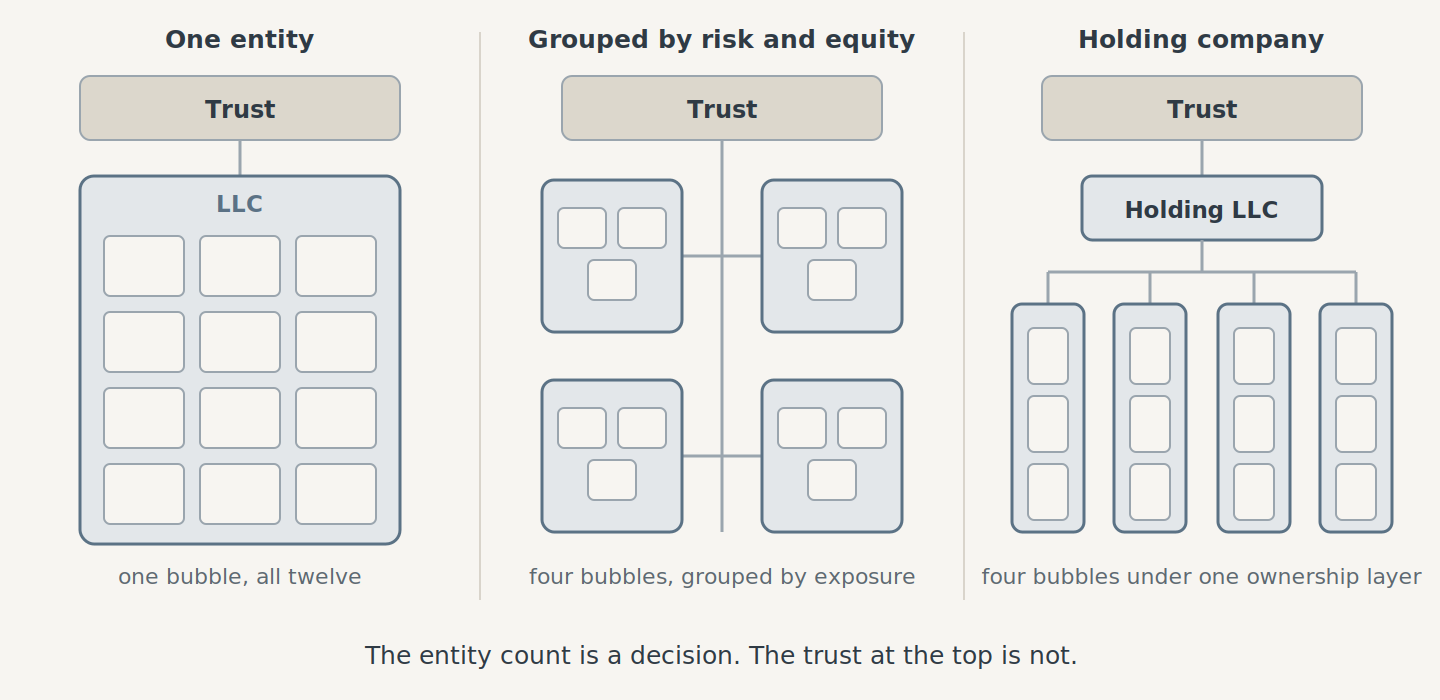
Everything in one LLC
Cheapest to run. One account, one filing, one return. It also means one bubble around the entire portfolio, so a single event can reach all of it. For a small number of low-equity properties this can be defensible. For a dozen properties with meaningful equity, the concentration is hard to justify.
One LLC per property
Maximum separation, maximum administrative load. This is the structure the client's bank and accountant described, and the cost objection to it is legitimate.
It also carries an upside that rarely comes up. When one LLC owns one property, the interest becomes portable. A sale can be done by transferring the membership interest rather than the real estate, which makes it an assignment governed by the operating agreement instead of a conveyance. No deed, no trip to the county clerk, and the change of hands does not surface in the public record where the property sits.
That cuts both ways, and the caveat is the same theme as the rest of this article. Someone buying the entity is buying everything the entity has ever done, including its tax history, its contracts, and any claim that has not surfaced yet. Clean books are what make that sale possible at a price you like. Read the loan documents before counting on any of it, because transferring membership interests will trip the due-on-sale clause in a lot of commercial notes.
Grouping by risk and equity
The middle path, and often the most practical one. Rather than counting properties, count exposure. Group them so no single bubble holds more equity than you are willing to lose in one event, and keep genuinely higher-risk properties in their own bubble. A short-term rental with a hot tub and a pool does not belong with a quiet long-term single-family rental that has had the same tenant for five years. Four or five thoughtfully drawn groups can capture most of the protective benefit of twelve at a fraction of the ongoing cost.
A holding company over property-level LLCs
A single holding LLC owns the property LLCs as their sole member, and the trust owns the holding company. This is often what people are reaching for when they feel the administrative weight of a flat structure.
It does two useful things. It consolidates the ownership layer, so the interest an outside-in creditor would chase sits in one place, which is where jurisdiction selection matters most. And when the subsidiaries are disregarded for tax purposes, it can collapse a stack of separate returns into a much simpler filing picture, which speaks directly to the accounting cost objection. Have that conversation with the CPA before anything gets formed, because the tax treatment shapes the structure and the structure shapes the tax treatment.
The caution is that choosing a favorable state for the holding company does not mean that state's law governs everything the structure touches. Where the real property sits carries real weight in a creditor fight, a point a recent federal decision drove home in the trust context.9 A Wyoming holding company over Colorado rentals is a structure worth taking to Matt. It is not a globe of invulnerability, and even that one comes with fine print about what it actually stops.
A series LLC
Worth addressing because it gets recommended online constantly. Matt tells me Wyoming does authorize series LLCs, with the liability separation among series set out in both the articles of organization and the operating agreement.10 Colorado does not have a series statute. Legislation to authorize protected series was introduced in 2020 and postponed indefinitely in committee.11
That gap matters. Using an out-of-state series structure to hold Colorado real estate asks a Colorado court to respect internal divisions that Colorado's own statutes do not describe, and the case law testing series separation across state lines and in bankruptcy is still thin. This is an area where the law is genuinely unsettled, and the administrative savings may not be worth the uncertainty. If someone recommends a series LLC for a Colorado portfolio, the follow-up question is what happens when a Colorado court, or a bankruptcy trustee, is asked to honor the separation.
Where the Trust Sits
Whatever the entity count, the top of the structure should be the same. The membership interests belong in the revocable living trust, not in the individual's name.
The clearest reason is continuity. If the owner becomes incapacitated, a successor trustee can step in and keep the properties running, sign leases, approve repairs, deal with lenders, without a guardianship proceeding. At death, the interests pass under the trust's terms without a probate freeze on a working portfolio.
The operating agreement can do part of this on its own. Colorado treats a transfer-on-death provision in a written instrument as nontestamentary, and an operating agreement qualifies, so a membership interest can be directed to a named person at death without probate and without a trust.12 That is a legitimate tool and worth knowing about.
What it does not cover is everything other than death. A transfer-on-death provision sits inert while you are alive and incapacitated, which is the more common and more disruptive event. It passes the interest outright, with no management behind it and no staged distribution for a beneficiary who is nineteen, or in a rough marriage, or bad with money. And across twelve entities it means twelve documents carrying dispositive terms that all have to stay consistent with each other and with the rest of the plan. Amend one, forget the other eleven, and you have built a conflict that surfaces at the worst possible moment.
Be precise about what the revocable trust is not doing, though. During your lifetime it is not adding a wall against your own creditors. A revocable trust is reachable by the grantor's creditors, and putting the LLCs inside it does not change that. Its work here is succession and continuity, which is a different job from asset protection and an equally important one.
After somebody dies, the people left behind face one of two conditions. They have an agreement that explains how the asset transfers, or they need a judge. Both the operating agreement and the trust are ways of staying in the first category.
The series has raised this question twice without answering it, so here is the answer. The operating agreement can settle the narrow question of who receives an interest. The trust settles the larger one of how the whole plan holds together, while you are alive and after you are not.13
Taking the Cost Objection Seriously
The client's real question underneath all of this was about cost, and it deserves a direct answer rather than treatment as an obstacle.
Separation has a price per unit, and that price is paid in three currencies.
Dollars. Formation, registered agent fees, annual reports, and tax preparation. Real, recurring, and easy to quantify. This is the currency where the objection has the most force, and a holding structure with disregarded subsidiaries is the most common way to reduce it.
Attention. Separate accounts to reconcile, separate records to keep straight, more opportunities to deposit a rent check in the wrong place.
This is the one people brace for, and it is smaller than it looks, because most of that work is work you should already be doing. You cannot tell which of twelve properties is actually earning its keep without tracking each one separately. Per-property books are how you learn that the duplex you are proud of is subsidizing the one you keep making excuses for. That accounting is the price of running a portfolio as a business, and it does not change much whether those properties sit in one LLC or twelve.
Which turns the objection into a useful diagnostic rather than a complaint. If tracking each property separately feels like overhead the structure is imposing on you, that is worth noticing on its own, because it means the portfolio's performance is currently invisible to you.
In a conversation with Chris J Snook a couple of weeks ago, I found myself drawing a line between an IRS hobby and what I ended up calling a behavioral hobby: something we keep doing because it is fun, familiar, and profitable, without ever pausing long enough to design what it is becoming.14 A dozen rentals throwing off real money can still be run that way. Someone who cannot say which property is the weak one does not have twelve investments yet.
So the honest accounting is that the fees go up and the recordkeeping mostly does not.
Credibility. Every entity you cannot maintain to a defensible standard becomes evidence against you. A structure that exists on paper and nowhere else is worse than no structure at all, because it invited the scrutiny without surviving it.
The right number of entities sits where the marginal protection of one more bubble stops beating the marginal cost of maintaining it, attention included. For someone with twelve properties, a property manager, and clean books, twelve entities may be entirely maintainable. For someone doing this alongside a demanding day job, five well-run bubbles will outperform twelve neglected ones, in cost and in a courtroom both.
That calculation is specific to the portfolio, the equity, the insurance, the risk profile of the properties, and the owner's real capacity to run the thing. Transfer tax planning can bear on entity count too, in a way that sometimes points the other direction, and that one belongs in a conversation with your CPA rather than a blog post.
Any advisor who gives you a number before asking those questions is selling formations.
The Better Question
"How many LLCs do I need" is a hard question to answer well because it starts in the wrong place.
The question that produces a good structure is this: what is the largest single loss I want to be survivable, which properties carry risk that could produce it, and what am I actually able to maintain for the next ten years?
Answer those three and the number falls out of them. The number is an output of the plan rather than the plan itself.
Final Thought
The client's instinct deserves credit. If a court can break one LLC, the existence of eleven more is not automatically comforting, and anyone who tells you otherwise is skipping the interesting part.
The structure holds because a creditor has to beat each entity on its own facts. Those facts are not fixed yet. You are writing them now, in the ordinary running of the portfolio. That means separate accounts, leases signed in the right capacity, repairs paid from the right place, records that match reality, and a number of entities small enough that you can actually keep all of that true.
Do that, and every bubble a creditor wants has to be taken on its own terms, in its own case, at their expense. You may still get beat. You will have made them make another play.
- In re Phillips, 139 P.3d 639 (Colo. 2006). Phillips involved a corporation and addressed outside reverse piercing, but its articulation of the alter ego standard reaches LLCs through Colo. Rev. Stat. § 7-80-107(1). It remains the leading Colorado authority on the standard. The dissent made a strong case that the record was not developed enough to support the result, which takes some weight off the holding without displacing it as the law in Colorado. ↩
- Id. The court cautioned that an equitable result is not achieved when innocent shareholders or creditors are prejudiced, and encouraged courts to consider whether alternative remedies are available before piercing. ↩
- Colo. Rev. Stat. § 7-80-107(2). Note that this addresses formalities specifically. It does not protect commingling of funds, which is a separate and far more damaging problem. ↩
- On why an operating agreement full of unfollowed requirements creates risk rather than reducing it, see How Plaintiff's Attorneys Destroy LLC Protection And How to Stop Them. ↩
- For a fuller explanation of charging orders and how they work, see Why Your Colorado Single-Member LLC May Not Protect You. On why the direction of a claim changes the whole analysis, see also The LLC Nobody Owns: What Happens When Formation Goes Wrong and What Does an LLC Actually Do? And What It Doesn't. ↩
- In re Albright, 291 B.R. 538 (Bankr. D. Colo. 2003). Colorado has not amended its statute to make the charging order an exclusive remedy against a single-member LLC. Wyoming has. See Wyo. Stat. § 17-29-503; Does It Matter Where You Form Your LLC? Why Wyoming Keeps Coming Up. ↩
- Martin v. Freeman, 2012 COA 21, 272 P.3d 1182 (Colo. App. 2012). ↩
- Dill v. Rembrandt Group, Inc., 2020 COA 69, 474 P.3d 176 (Colo. App. 2020). The court held that horizontal piercing may reach entities that share common owners only indirectly, but that the veil between each entity and the common owners must be pierced separately, with alter ego established at each step. ↩
- United States v. Huckaby, No. 2:23-cv-00587-DAD-JDP, 2026 WL 587784 (E.D. Cal. Mar. 3, 2026). For a fuller discussion, see What the Huckaby Case Means for Asset Protection Trusts in 2026. The choice-of-law questions in cross-border asset protection remain unsettled. ↩
- Wyo. Stat. § 17-29-211(b), (c). The limitations on liability among series must be set out in both the articles of organization and the operating agreement. ↩
- Colorado HB20-1096, the proposed Colorado Uniform Protected Series Act, was postponed indefinitely in the House Judiciary Committee in 2020. ↩
- Colo. Rev. Stat. § 15-15-101 (a provision for a nonprobate transfer on death in a "written instrument of a similar nature" is nontestamentary). This discussion is limited to Colorado law. We have not analyzed whether Wyoming reaches the same result. ↩
- For more on what a revocable trust does during your lifetime, see Stop Thinking About Your Trust as a Death Document. ↩
- Chris J Snook and Owen Hathaway, Your Hobby Makes Real Money. That Does Not Mean You Built a Business., Wealth Matters 3.0, July 31, 2026, the written companion to a live ATOMIQ LEVEL conversation. Note that Chris's post sits behind his subscriber paywall. ↩