
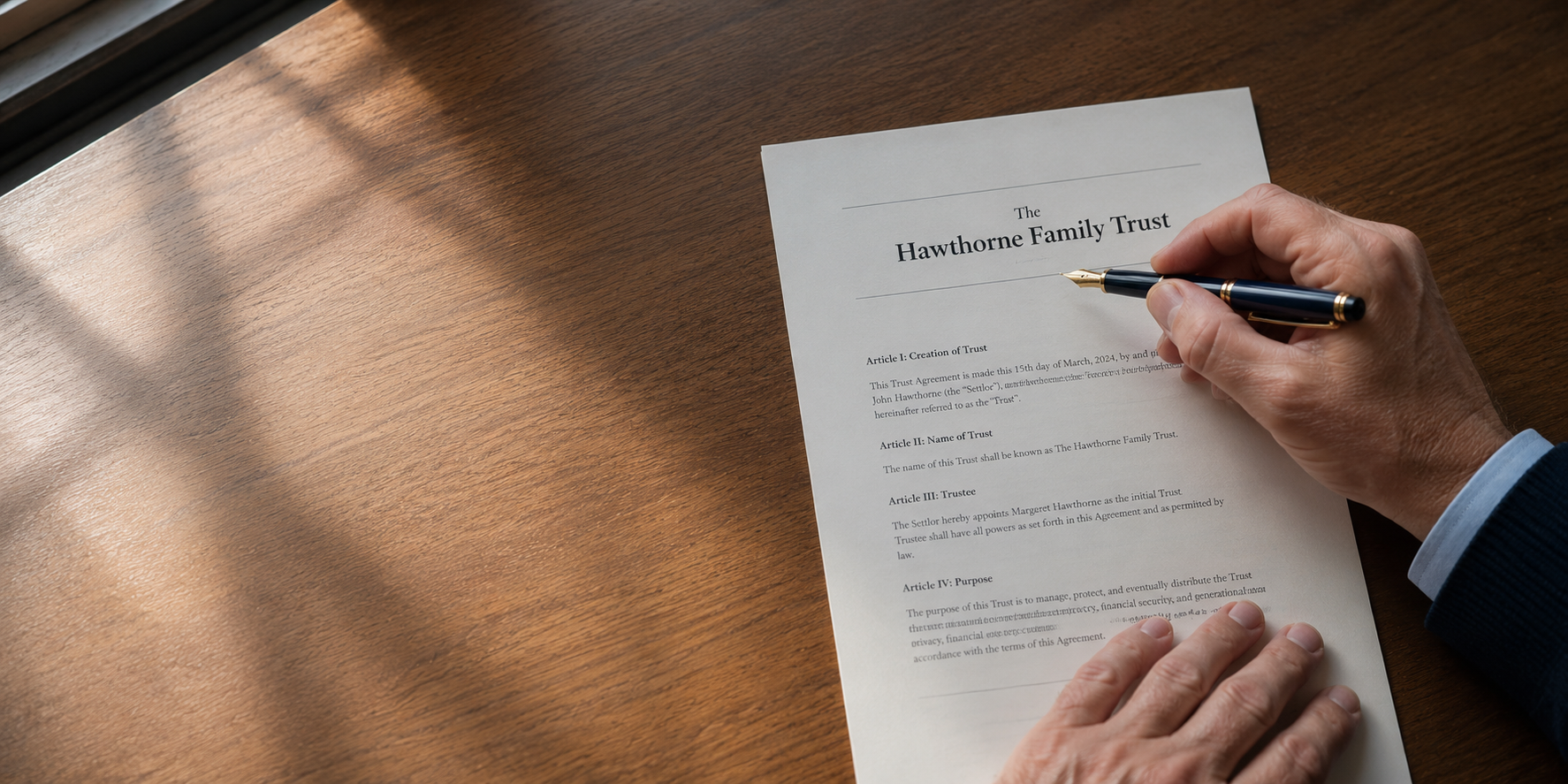
Here is a question I have answered more times than I can count: is the word "The" actually part of my trust's name?
It usually comes up when someone is staring at their own documents and noticing that the word does not behave. It is "The Smith Family Trust" on the signature page, "the Smith Family Trust" in a paragraph three pages later, and just "Smith Family Trust" on the bank's signature card. So which one is right? Did somebody make a mistake? And if "The" is capitalized in the title, doesn't that make it the official, legal, capital-T version of the name?
I love this question, partly because it is a fair one and partly because the honest answer is more reassuring than people expect. The short version: the article "The" almost never carries the legal weight people assume it does. What identifies your trust is something sturdier than a capital letter. But, and this is the part worth your attention, the institutions you deal with do not always know that, so consistency still earns its keep.
Let me walk through both halves of that.
What Actually Identifies a Trust
A trust is not a registered name the way a corporation or an LLC is. When you form an LLC, you file a name with the Secretary of State, and that exact string of characters becomes the entity's legal identity. A trust works differently. It is a private arrangement, created by a document, and it is identified by a combination of things rather than one official line of text.
In practice, three pieces do the identifying: the name of the trust, the date it was established, and the people serving as trustees. "The Smith Family Trust dated March 3, 2026, Jane Smith and John Smith, Trustees" is doing real identifying work. The "The" at the front is a label of convention, a way we refer to the thing, not a registered identifier that changes meaning depending on whether someone reached for the shift key.
That is why you see the word capitalized in some places and not others. At the start of a title or a defined term, it gets a capital letter because that is how titles and defined terms are styled. Mid-sentence, it is just an ordinary article, the same "the" you would put in front of any noun. Both are referring to the same trust. Neither one is the secret true name.
So when a client tells me they were confused because "The" was capitalized here and lowercase there, I tell them the capitalization is a grammar decision, not a legal one. The trust is the same trust either way.
The Law Builds In Some Forgiveness
If you need proof that the article is not sacred, look at how the professionals handle it.
I recently reviewed a trust for a client who was settling a deceased spouse's trust. The certificate of trust, prepared years earlier by another attorney, directed that assets be titled this way: "Thomas Jefferson, Trustee of The Thomas Jefferson Trust dated July 4, 1976," capital "The." But the trust instrument it was based on, in its own instruction for how to title property, called for "Thomas Jefferson, Trustee of the Thomas Jefferson Trust dated July 4, 1976, and any amendments thereto," lowercase "the." Same plan, same drafter, two versions of the word sitting a few pages apart, and they did not even agree on how much of the name to include. If the lawyer who wrote it did not treat the article as fixed, that tells you how much weight it really carries.
And then the trust did something I wish more people noticed in their own documents. It included a line, standard in well-drafted trusts, saying in effect that any description of the trust will be effective as long as it reasonably identifies the trust and indicates that the property is held in a fiduciary capacity.
Read that phrase again: reasonably identifies the trust. That is the actual standard, written right into the document. Not a perfect, character-for-character match. A description a reasonable person would recognize as pointing to this trust, held in trust. The drafters knew that a trust's name gets written a little differently across deeds, account forms, and the passage of years, so they built in room for exactly that. The goal is recognizability, not orthographic perfection.
That one clause is this entire article in a sentence.
Where It Stops Being Just Grammar
Now for the part that keeps this from being a tidy little grammar lesson.
I have had deeds bounce back from a recording office because the word "The" was not capitalized, where the clerk reviewing the document believed the article was a formal part of the trust's legal name and that the deed therefore did not match. The law does not require that level of precision about an article. The clerk's desk, on that particular day, did.
Arguing the finer points of trust identification with a recording office is a losing way to spend an afternoon. What actually fixed it was practical, not philosophical. We prepared a fresh certificate of trust, the short document that confirms a trust exists and states its name, date, and trustees, so the title matched cleanly and the deed could record.1 The trust had not changed. The paperwork just needed to speak the institution's language.
That experience captures the whole lesson. You can be completely right about what the law requires and still be stuck, because the bank teller, the title company, the recording clerk, and the brokerage's account-titling system each have their own rules and their own comfort level. They are not going to litigate trust law with you at the counter. They are going to compare two strings of text and decide whether they match.
Consistency Is the Real Lesson
This is why I tell clients to worry less about whether "The" is technically part of the name and more about using the same version of the name everywhere.
Pick how your trust's name reads, the full version with the date and trustees, and then carry it consistently across the places that matter: the deeds to your real estate, the certificate of trust you hand to third parties, your account titling at the bank and brokerage, and your beneficiary designations.2 When all of those agree, you rarely have to think about any of this again. When they drift apart, you create little mismatches that some institution, somewhere, will eventually flag, usually at the least convenient moment, like a closing or a transfer after a death.
The cost of an inconsistency is almost never that your plan fails. The cost is friction: a rejected deed, a delayed account transfer, an afternoon spent redoing a document that was substantively fine. Consistency is cheap insurance against that friction, and it is entirely within your control.
Final Thought
So, is "The" part of your trust's name? Legally, it is along for the ride, not steering. Your trust is identified by its name, its date, and its trustees, and a capital letter does not change what the trust is.
But the people across the counter do not all know that, and they are the ones who record your deeds and title your accounts. So the practical answer is the one worth remembering: it matters less than you fear, and consistency matters more than the "The." Get the name right once, use it the same way everywhere, and the grammar can take care of itself.
- A certificate of trust (sometimes called a certification of trust) lets a trustee confirm a trust's existence, its date, the identity of the trustees, and how title to trust property is taken, without handing over the entire trust instrument. See Colo. Rev. Stat. § 15-5-1013; Wyo. Stat. § 4-10-1014. ↩
- For a fuller walk through aligning your trust with deeds, account titling, and beneficiary forms, see How to Coordinate Your Colorado or Wyoming Living Trust With Property Titles and Beneficiary Designations in this series. For why your trust is meant to work during your lifetime and not just sit in a binder, see Stop Thinking About Your Trust as a Death Document. ↩