
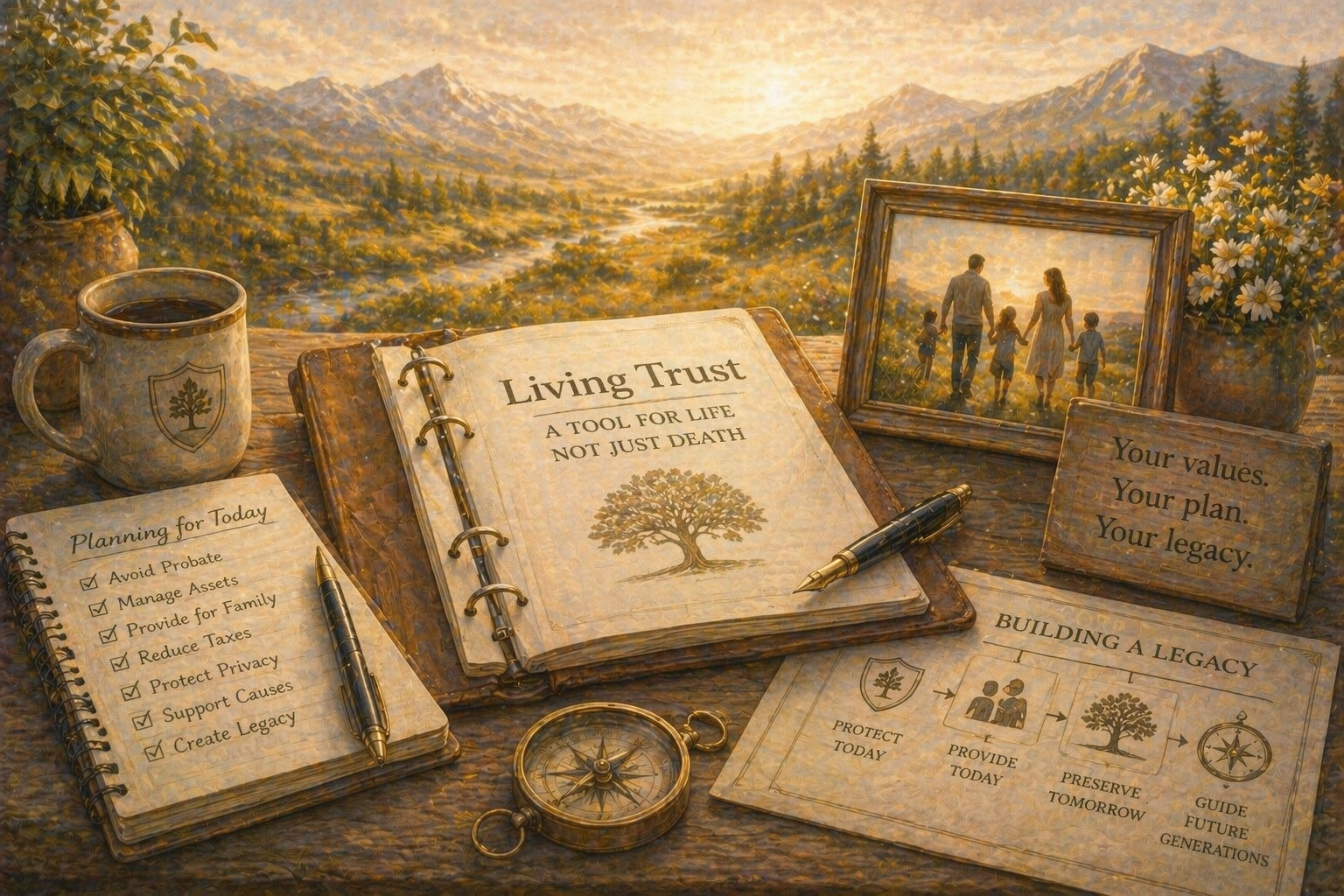
For a lot of families, the word "trust" calls up the same picture: a thick binder, a stack of signatures, a document that matters someday, probably after a funeral.
I understand where that picture comes from. Most people first encounter a trust when a parent dies, or when an advisor tells them they need one "for the estate." So the trust gets filed away, mentally and physically, as a thing for later.
That mindset costs families real money and real flexibility, because a well-designed revocable living trust does most of its quiet work while you are alive. And, just as important, a trust drafted by someone who shares that death-document mindset can end up restricting you, the living person it was supposed to serve.
Let's take those one at a time.
What Your Trust Is Doing While You're Alive
When I talk about trusts in this article, I mean the revocable living trust, the foundation document most Colorado and Wyoming families use as the centerpiece of their estate plan. You create it, you can amend it, you can revoke it, and in most cases you serve as your own trustee while you are alive and well.
So what is it actually doing during your lifetime?
It is organizing ownership. Assets titled in the trust are gathered under one set of instructions instead of scattered across accounts, deeds, and beneficiary forms that may not agree with each other.
It is standing by for incapacity. This is the part people underestimate. If a stroke or a dementia diagnosis takes you out of the driver's seat, a funded trust keeps functioning. Your successor trustee steps in under the terms you wrote, pays your bills, manages your property, and keeps your family out of a court-supervised conservatorship. Choosing that successor well matters as much as the document itself.1
It is preserving privacy and continuity. Trust administration happens without the public filings that come with probate, and there is no gap where assets sit frozen waiting for a court to appoint someone.
And it is holding the instructions for later: who benefits, when, and with what guardrails.
That last item, the death-and-distribution part, is the only one most people think about. It is maybe a quarter of what the document does.
One Thing Your Revocable Trust Is Not Doing
Here is where precision matters, because this is the most common misunderstanding I see.
A revocable living trust does not protect your assets from your own creditors. You can amend it, revoke it, and take everything back, so the law treats the assets as yours. Both Colorado and Wyoming follow this rule by statute: while you are alive, property in your revocable trust is subject to the claims of your creditors.2
That is not a flaw in the revocable trust. It was never built for that job.
Protection from your own creditors requires irrevocable structures, and those come with real tradeoffs in control and access. Even then, the structure and the geography both have to be right. Matt wrote recently about a federal court decision where a Nevada asset protection trust failed to shield California real estate, largely because the people who created it gave up nothing, kept every role, and ignored where the property actually sat.3 If asset protection is your goal, that is a different conversation and a different set of tools.4
Where trusts shine on protection is the other direction: the beneficiary side. Assets your trust holds for your children after you are gone can be very well protected from their creditors, their divorces, and sometimes their own worst impulses. But that protection depends on how the distribution rules are designed, which is its own topic.5
The Drafting Mistake That Locks You Out of Your Own Trust
Now for the part that surprises people. The death-document mindset does not just live in clients' heads. It shows up in drafting.
Matt has a sharp way of putting this: some trusts are written as if you were already dead.
Here is what he means. The restrictions that make sense for a successor trustee, someone managing assets for your beneficiaries after your death, sometimes get loaded into the trustee provisions that apply during your lifetime. Distribution standards, spending limitations, procedural hurdles, all of it sensible for protecting beneficiaries later, none of it sensible for a healthy grantor managing their own money now.
The result is a living person who has to tiptoe around their own assets. We have seen trusts where the grantor would technically need to document that a purchase fell within an ascertainable standard before spending their own savings.
The fix is not legal theory. It is drafting discipline. While you are alive and well, your powers as trustee of your own revocable trust should be broad, essentially as broad as outright ownership. The restrictions should switch on when they are needed, at incapacity or at death, and not before.
If you are reading your trust and it feels like you need permission to live your own life, that is not a sign of sophisticated planning. It is a sign the drafter never separated the document's two phases.
A Trust Is a System, Not a Vault
Once you stop seeing the trust as a binder for someday, the planning conversation changes.
Families who treat the trust as a living structure tend to keep it funded, because they understand an empty trust does nothing. They review it when life changes, because they expect it to keep up. They prepare their successor trustees instead of leaving them a surprise. And when the plan eventually shifts to the next generation, the beneficiaries inherit a working system with guardrails, not a vault to be cracked open and emptied.
That is also where the lifestyle question becomes useful. For the irrevocable trusts that do protect beneficiaries, the design question is not just "who gets what" but "how should these assets support the people I love." A trust that owns or pays for things that support a beneficiary's life can keep assets inside the protected structure. A trust that simply pushes unrestricted cash into a beneficiary's personal account gives up much of that protection at the moment of transfer. When, why, and how distributions happen is where the real design work lives.5
Final Thought
A good trust answers two questions, not one.
Who gets what when you are gone. And how the plan serves you and the people you love while everyone is still here.
Drafted with both questions in mind, a revocable living trust works for you during your life, steps in seamlessly if you become incapacitated, and hands your beneficiaries a structure built to protect them. Drafted as a death document, it sits in a binder doing a fraction of its job, and it may even get in your way.
If your trust only answers the first question, it is worth a second look.
- See How to Choose a Trustee in Colorado or Wyoming in this series, on what makes a successor trustee likely to succeed when the document hands them the job. ↩
- Colo. Rev. Stat. § 15-5-505(1)(a) (during the lifetime of the settlor, the property of a revocable trust is subject to claims of the settlor's creditors); Wyo. Stat. § 4-10-506(a) (same rule under Wyoming's Uniform Trust Code). ↩
- United States v. Huckaby, No. 2:23-cv-00587-DAD-JDP, 2026 WL 587784 (E.D. Cal. Mar. 3, 2026). See What the Huckaby Case Means for Asset Protection Trusts in 2026 in this series. ↩
- Wyoming authorizes qualified spendthrift trusts, Wyo. Stat. §§ 4-10-510 through 4-10-523, one of the stronger domestic asset protection trust statutes. The protection comes with real tradeoffs in control and access, and as Huckaby illustrates, the structure and the location of the property both matter. ↩
- See How to Design Trust Distribution Rules That Protect Colorado and Wyoming Beneficiaries from Themselves and Others in this series. ↩