
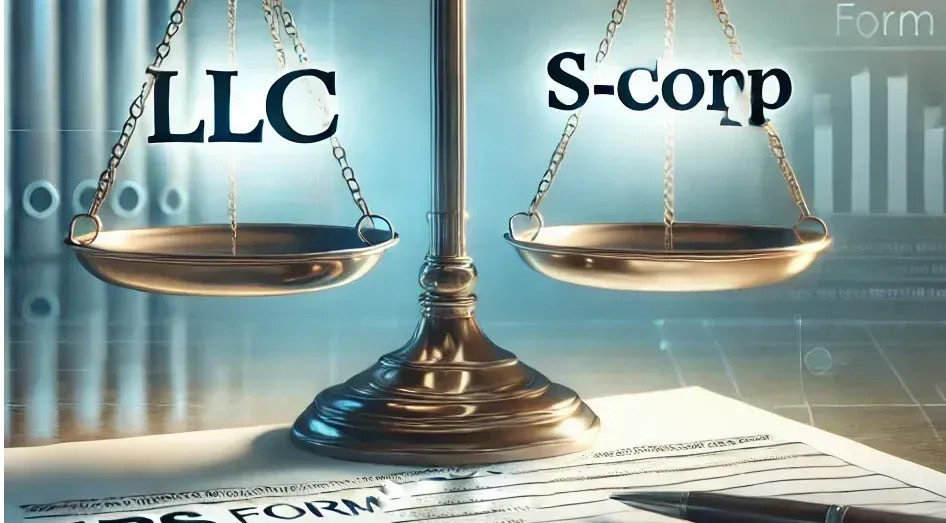
One of the most common misconceptions we run into when advising small business owners is the belief that Limited Liability Companies (LLCs) and S corporations are competing business structures. You might have heard someone ask, "Should I form an LLC or an S corporation?" We even hear from clients that their accountant advised them to "reincorporate as an S corporation for the tax savings." That question contains a fundamental misunderstanding, one that can lead to confusion, needless expense, and can even undermine the liability protection you put in place by creating an LLC.1
The Critical Distinction
Here is the reality:
- An LLC is a business entity type created under state law.
- An S corporation is a tax classification elected with the IRS.
This distinction matters, because it means you are not choosing between an LLC and an S corporation. You are first selecting your business entity (and I always start by asking, "Why not an LLC?"), and then deciding how that entity will be taxed.
How LLCs Are Typically Taxed
By default, LLCs are taxed according to their ownership structure:
- Single-member LLCs are taxed as sole proprietorships, with pass-through taxation reported on your personal return (Schedule C).
- Multi-member LLCs are taxed as partnerships (Form 1065, with a K-1 for each member).
These default tax treatments offer simplicity and flexibility, which is part of why many small business owners choose the LLC structure in the first place.
The S Corporation Tax Election
Here is where S corporations enter the picture: an LLC can elect to be taxed as an S corporation while keeping its LLC legal structure. The election is made by filing Form 2553 with the IRS.
When an LLC elects S corporation taxation:
- The business remains an LLC under state law.
- The business files Form 1120-S for federal taxes.
- The owners receive K-1 forms showing their share of business income.
- The business can potentially reduce self-employment taxes on a portion of income.
Potential Benefits of S Corporation Taxation
The primary advantage of S corporation taxation is the potential savings on self-employment taxes. With default LLC taxation, all profits are typically subject to self-employment tax (15.3% for Social Security and Medicare).
With S corporation taxation, you can:
- Pay yourself a "reasonable salary" that is subject to employment taxes.
- Take additional profits as distributions that are not subject to self-employment taxes.
This arrangement can produce meaningful tax savings for profitable businesses, though the exact amount depends on your specific financial situation.
Additional Requirements for S Corporation Taxation
The potential tax benefits come with additional responsibilities:
- Reasonable salary requirement. You must pay yourself a salary comparable to what would be paid for similar services in your industry. Determining what counts as "reasonable" is very much an art, and it can get complicated.
- More formalized accounting. You need more detailed bookkeeping and a clean separation between salary and distributions. Your books tell a story, and that story needs to make sense under the rules you have chosen to take advantage of.
- Ownership restrictions. An S corporation is limited to 100 shareholders, one class of stock, and certain kinds of shareholders. Typically, only humans with bellybuttons, or their direct representatives like a trust or a probate estate, can own an interest in an S corporation.2
- Additional filing requirements. Expect more complex tax returns and potential state tax considerations.
When S Corporation Taxation Makes Sense
S corporation taxation tends to become advantageous when:
- Your business consistently generates profits above what would be a reasonable salary.
- The tax savings outweigh the additional accounting and administrative costs.
- You can satisfy the reasonable salary requirement and the other restrictions.
Common Pitfalls to Avoid
Many business owners make these mistakes:
- Forming a corporation instead of an LLC when they simply want S corporation taxation.
- Making the S election too early, before the business generates enough profit to justify it.
- Taking too little salary in an effort to minimize employment taxes, which is a red flag for IRS audits.
- Not understanding, or simply ignoring, the additional compliance requirements.
Making the Right Choice for Your Business
The decision about your business entity and its tax treatment should rest on several factors: your liability protection needs, your appetite for administrative simplicity, your growth plans (are you in business to live your life with it, or are you in it to grow and sell?), your profit projections, and your personal tax situation.
So rather than asking "LLC or S corp?", the better questions are:
- What business entity gives me the right liability protection and flexibility for my business?
- How should that entity be taxed to optimize my overall tax situation?
Understanding that an LLC is a business entity, while an S corporation is a tax classification, clears up much of the confusion around this topic. In most cases, forming an LLC and then making an informed decision about its tax treatment, default or S corporation, gives you the best combination of liability protection, flexibility, and potential tax advantages.3
- An LLC only protects you if it is actually built and maintained to do so. Ownership, authority, and documentation all matter, and a tax election does nothing to fix gaps in those. For what happens when those pieces are missing, see The LLC Nobody Owns: What Happens When Formation Goes Wrong. ↩
- S corporation eligibility, including the 100-shareholder cap, the single-class-of-stock rule, and the limits on who may hold shares, comes from Subchapter S of the Internal Revenue Code. See I.R.C. §§ 1361–1362. An LLC makes the election on IRS Form 2553. ↩
- For a plain-language look at what an LLC does and does not do, see What Does an LLC Actually Do?. And because where you form an entity can matter as much as how it is taxed, see Does It Matter Where You Form Your LLC?. ↩